
Westminster City Directory Holdings
Westminster's historic directory record is a shelf of uneven runs, not a continuous annual series. The earliest anchor is an 1887 local directory. It appears in the National Register bibliography. From there the record shifts to telephone and regional books preserved through Library of Congress holdings. Those national volumes rarely tell the whole story. The Historical Society of Carroll County, the Westminster Branch, and the Carroll County Genealogical Society add local files, maps, newspapers, and reference material. Such extras help interpret what a directory leaves unsaid.
| Collection | Known years | Where held | Access |
|---|---|---|---|
| Westminster - Its Location and Advantages, including a directory | 1887 | HSCC and local collection references | Research library or appointment route |
| Official telephone list | 1895–1897; 1899–1901 | Library of Congress | Catalog and telephone-directory guide |
| Carroll County and regional white/yellow pages | 1954–1956; 1957–1961; 1963; 1965 | Library of Congress holdings | Consult the exact volume and year |
| Westminster White/Yellow Pages | July 1972–July 1973 | Library of Congress | Direct local title/run |
| Polk’s Westminster directory | Year not verified | FamilySearch catalog lead; verify at HSCC | Do not assume a complete run |
The dates mark surviving evidence. They do not list every year a directory was issued. The earliest local directory, the telephone exchanges, and the regional books each cover different ground. The later Westminster title covers different ground too. Read the title page and the front matter. Check the geographic scope before treating an entry as proof that a person lived inside the present city limit.
Westminster Directory: 1887
The 1887 Vanderford Brothers volume is the clearest named anchor for historical Westminster directory research. Its full title is Westminster - Its Location and Advantages as a Place of Residence or Business, Including a Directory. The Democratic Advocate published it in Westminster. The National Register bibliography identifies the work. HSCC and local collections are the right places to verify its format, condition, and available pages. It is no modern household roll.
Start with the name as it appears in family papers. Then try initials and spelling variants. A listing can place a name in the community. It may even add a street or business clue. Exact fields must be read from the page itself. The same person can appear under a different form in the Democratic Advocate, a deed, a cemetery record, or later telephone material. Record the page number, the publication date, and the heading. Those details make later comparisons far more reliable.
Westminster Telephone Directory Runs
Telephone books form their own branch of the Westminster residents directory trail. The Library of Congress traces Maryland telephone lists from 1895 through 1897. It covers them again from 1899 through 1901. Westminster appears in both stretches. Later regional volumes carry Carroll County coverage deep into the twentieth century. For the city itself, the direct White and Yellow Pages run covers only one stretch. It runs from July 1972 through July 1973. A subscriber listing is helpful evidence for a Westminster street directory search. Still, it proves neither ownership nor every person at an address. The Library of Congress telephone-directory guide documents the full holdings that include Westminster.
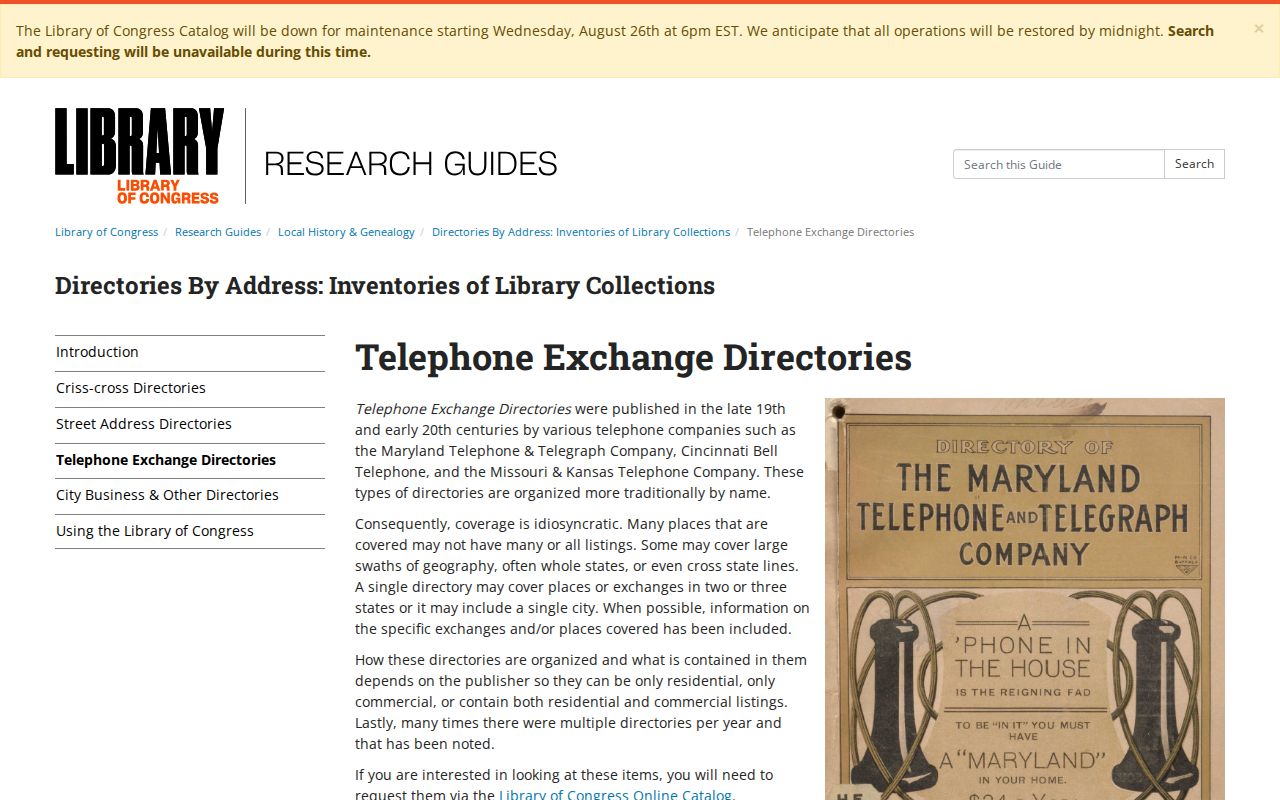
Telling a local Westminster title from a countywide exchange book matters. The difference shapes how you weigh a subscriber name against a street address. A name may turn up in one of these volumes. Note exactly what kind of book it came from. White pages, yellow pages, a local title, or a regional exchange list each carry different weight in a resident lookup. A business classification can point toward a newspaper advertisement or a community organization. The address or phone format can also help date the clue. Missing years are normal. Bridge those gaps with other local records. Don't guess them away.
Westminster Historical Directory Shelves
Printed directories are only the start of Westminster's research shelf. The Carroll County Genealogical Society collection at Westminster Branch holds more than 1,400 reference items. Books, journals, maps, family histories, and self-published works all sit in that collection. Unique family-research compilations join them there. Everything is reference-only. Research Thursdays run from 1 to 4 p.m. The society asks researchers to call ahead. Bring a surname, an address, and a date range.
The Historical Society of Carroll County offers a second route at 210 East Main Street. Its research library keeps directories, vertical files, microfilm indexes, family files, maps, and cemetery material. None of it has ever been digitized. Appointments are encouraged, and some non-digitized material requires one. The stated non-member fee is $5 per day. Members, students, Carroll County Genealogical Society members, and area historical organizations are exempt. The visit page lists Wednesday through Saturday hours, noon to 4 p.m. It directs researchers to call ahead for anything not digitized. HSCC's research-library visit information spells out the local access route.
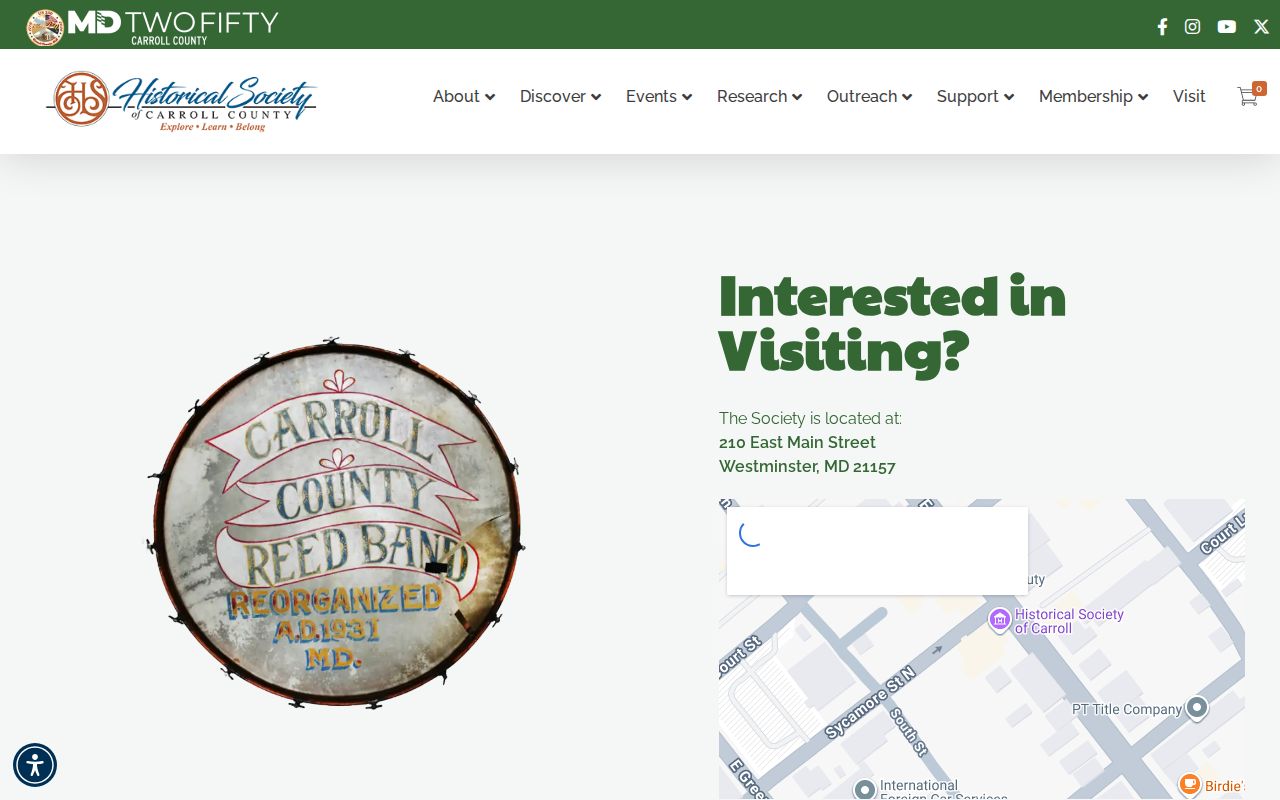
A research library comes in handy whenever a catalog points to a Westminster directory volume that has never been digitized for viewing online. The shelf copy is often the only way to read it.
Reading Westminster Directory Entries
A Westminster directory entry rewards a close read. Alphabetical listings open with a surname and initials. Addresses may appear as a simple street and number. Telephone sections sometimes use an exchange or a name-number form instead. Older volumes often add a business or trade line. A spouse or status notation may sit beside it. Street sections and a publisher's abbreviation key can help too. Treat these fields as clues to confirm in the edition at hand rather than guarantees of what every Westminster residents directory run contains.
| Alphabetical name | Record the surname, initials, and spelling variants exactly as printed. |
|---|---|
| Address | Capture the street and number when supplied; telephone books may instead use an exchange or name-number format. |
| Business or trade text | It may appear in a printed directory, but telephone-only volumes do not guarantee it. |
| Household notation | Spouse, widow, owner, or household marks require page-level confirmation in the actual edition. |
| Street or reverse section | Some runs may support address-to-name research; its presence is not confirmed for every Westminster volume. |
- Criss-cross directory
- A street-order section, when a volume includes one, used to approach entries from an address rather than a name.
- Householder index
- An index organized around the named household or address entry, distinct from a full census schedule.
- Abbreviation key
- Front matter that explains the volume's shorthand; save it with any page transcription.
Westminster Directories and Maps
A Westminster directory entry gains real force once its address sits on a map. Sanborn fire-insurance maps survive for 1887, 1892, 1897, 1904, 1910, 1918, 1927, and 1959. They reveal footprints, building material, use, and numbering. The sheets rarely name occupants, though. When a modern street name clashes with an older entry, the 1877 atlas, Maryland Inventory of Historic Properties files, and historic-district records offer further checks.
HSCC's newspaper trail catches moves, deaths, civic events, and address mentions a directory never captured. Its named runs include the Democratic Advocate from 1865 to 1947, the Carroll News from 1886 to 1889, and The Times or Carroll County Times from 1911 to 1973. The Union Bridge Pilot spans 1899 to 1972. That range covers nearly a century of local life.
For page-level keyword work, HSCC's Digital Library is the source. It digitizes newspapers, journals, exhibits, and finding aids. Deep name and address hunting is best done there.
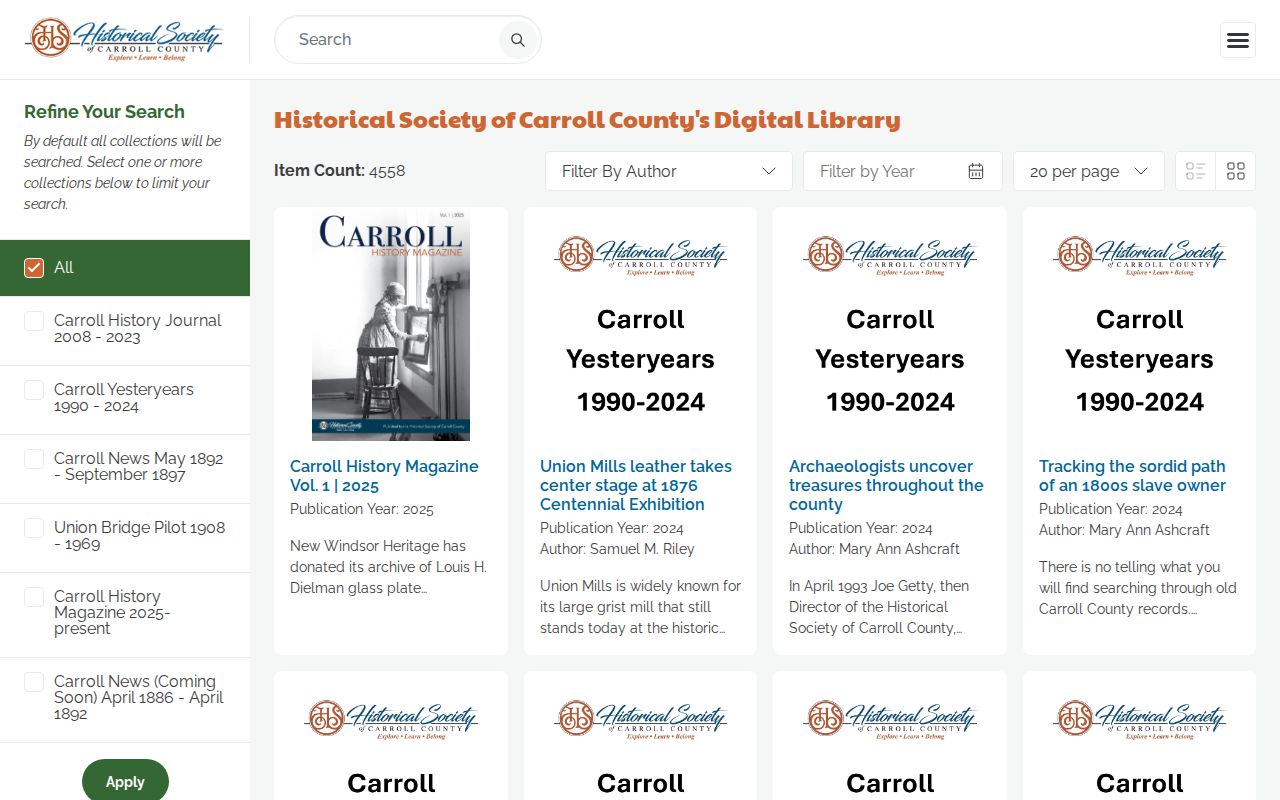
CatalogIt handles objects, photographs, and single archival items. The Digital Library, by contrast, is the right space for full-document keyword work.
Modern parcel records answer a different question. Once an old directory address has been reconciled to a current parcel, the Westminster street records route supplies the current property-led chain without replacing the historical evidence.
Tracing Westminster Directories
Read each Westminster historical volume as a dated observation. Start with one confirmed spelling or address. Then move only to volumes that actually exist for the era in question. Pair each date with the federal census released for that period. Census schedules follow the federal 72-year rule. Household relationships and enumeration geography often explain why a name appears in a wider Westminster district yet not inside the incorporated city.
- Copy the spelling, address, headings, abbreviations, and publication details from the first located entry.
- Check the alphabetical portion and then the street or reverse portion if that edition has one.
- Move backward or forward one available edition at a time, treating a gap as a gap rather than a proven move.
- Compare each period with the released census, checking the city and district geography before joining records.
- Close uncertain stretches with deeds, obituaries, probate, newspapers, permits, cemetery resources, or family files.
A disappearance can mean many things. It may signal a move, a death, a changed spelling, a household without a telephone, thin rural coverage, or a compiler's timing. Trust agreement among dated sources, not one absent listing.
Westminster Names Before 1768
Older search terms need a local adjustment. Westminster began as Winchester's Town in 1764. Mail kept confusing it with Winchester, Virginia, so the town took its current name in 1768. Nineteenth-century newspapers, directories, correspondence, and land records may therefore lean on a town, route, turnpike, church, inn, or older place form rather than a familiar modern address. Test the historic name alongside the surname. Keep the original wording in your notes.
This naming quirk helps when a directory search fails. A person may sit in the Westminster district, on a county road, or under a pre-modern place description with no entry in the current city form. The 1877 atlas, Sanborn sheets, legal descriptions, and historic files can connect those forms. They do so without inventing a street change the record never shows.